
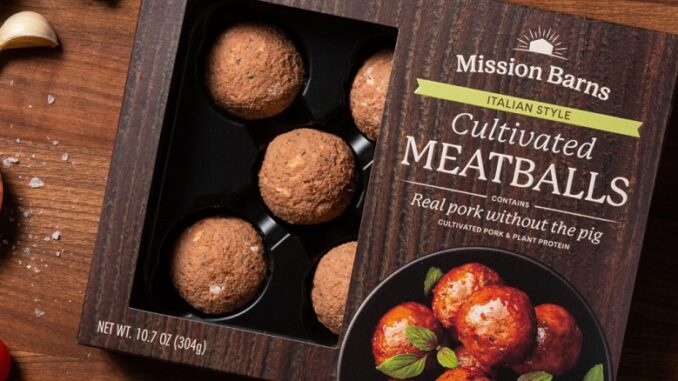
Mission Barns, a California-based startup pioneering the cultivation of animal fat in proprietary bioreactors, has received final regulatory clearance from the US Department of Agriculture.
The approval includes both a grant of inspection for its production facility and label authorization for its cultivated pork fat, which had previously gained a nod from the Food and Drug Administration earlier this year.
With full US regulatory approval now secured, Mission Barns is set to launch its first products in the third quarter. According to Chief Business Officer Cecilia Chang, the company’s cultivated fat will debut in meatballs and bacon at San Francisco’s Fiorella restaurant group, and in meatballs at a Sprouts Farmers Market location in the Bay Area. “Our mission has always been to solve the biggest barrier to alternative proteins: taste,” said Chang in a statement to AgFunderNews. “Cultivated fat is the key.”
The USDA-approved retail label will read: “Cultivated meatballs. Contains real pork without the pig, cultivated pork & plant protein.”
Mission Barns becomes the first company to receive US regulatory clearance for cell-cultivated animal fat, and only the fourth to obtain full federal approval for cultivated animal cells intended for human consumption, joining the ranks of UPSIDE Foods, GOOD Meat, and Wild Type.
According to AFN, Mission Barns is now in discussions with partners in the consumer packaged goods, ingredient, and meat sectors to initiate small-scale product trials. The aim is to gauge consumer response in a variety of market settings. The company currently operates a pilot facility in the San Francisco Bay Area.
Rather than building a commercial-scale production facility in-house, Mission Barns plans to license its proprietary bioreactor technology to established manufacturers. “We’ve talked to partners and done the modeling,” Chang told AgFunderNews. “The cost is much lower for companies that have existing infrastructure, which is why we’re really targeting those players. Let’s expand into an existing facility. Let’s take over a decommissioned facility or underutilized, under capacity facility.”
The company believes its bioreactor design can drive down production costs significantly. “Based on our techno economic analysis, we believe that we can be competitive with conventional pork fat at 20,000 liters,” said Chang.
Founded in 2018, Mission Barns has raised more than $60 million to date and is in the process of securing additional capital. Chang acknowledged a shifting landscape for the alternative protein sector in her conversation with AFN. “It’s no secret that the sentiment [around cultivated meat and alt proteins in general] has definitely changed over the last few years, and there are a lot more questions around both economic and technical viability,” she said.
As Mission Barns gears up for its first product launches, its success could mark a critical milestone for the cultivated fat category—an emerging area that industry observers believe may hold the key to making alternative proteins more palatable to mainstream consumers.
Find out more at: https://missionbarns.com/