
After enjoying several years of accelerated growth, the European market for plant-based meats is undergoing a recalibration.
Sales volumes fell 3.4% in 2023 compared with 2022, according to Nielsen data, signaling a waning in the initial wave of enthusiasm. Yet demand remains far from extinguished.
One in four European shoppers still includes meat alternatives in a typical grocery basket, reports Innova Market Insights. The sector has even shown early signs of recovery in 2024, posting a 2.3% increase in volume compared with the previous year.
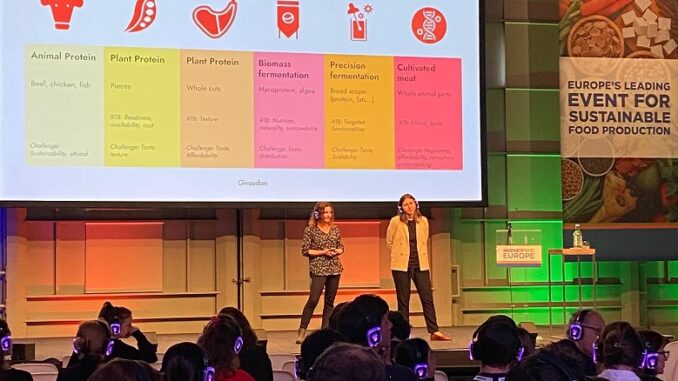
At the recent Bridge2Food 2025 summit in the Netherlands, Laurence Minisini, Senior Consumer & Market Insights Manager at Givaudan, presented a research-based perspective on five key trends reshaping the plant-based meat sector. These insights are drawn from proprietary studies conducted with more than 3,000 European consumers and 250 industry experts.
“Health and nutrition are non-negotiable,” Minisini said, emphasizing how today’s consumers are closely evaluating the nutritional profile of meat alternatives. Although 54% of Europeans have sampled plant-based meat, Givaudan’s research reveals that 12% have since stopped and another 17% have scaled back their consumption, frequently citing health concerns. Consumers are increasingly seeking clear labeling around protein content, fiber, calorie count and additives. According to Givaudan, this points to a need for innovation that is not only science-backed but also transparently communicated.
Taste and texture remain formidable barriers. A significant number of consumers—32% across Europe—remain hesitant to try plant-based meat, often citing disappointing sensory experiences. “Enjoyment and novelty,” Minisini noted, “are critical, just as they are in any other food category.” Many current offerings fall short of replicating the tactile and flavor dimensions of animal protein. Consumers are looking for excitement and diversity—products such as tender pulled ‘meat’, savory ‘pork’ skewers or juicy ‘chicken’ wings that deliver more than just substitution.
Givaudan is responding to these challenges with a suite of technological initiatives. Efforts are underway to mask undesirable flavor notes, enhance mouthfeel, and replicate the cooking behavior of conventional meat. The company is also exploring emerging technologies like 3D printing and biotechnologies such as mycoproteins, algae-based ingredients, and cellular agriculture. These platforms offer novel textures and nutritional profiles, and may allow the development of whole cuts and hybrid products that expand the boundaries of what alternative protein can be.
Beyond mimicry, a new consumer segment is gravitating toward products that are “Truly Not Meat”—bold, plant-forward foods designed not to imitate but to stand apart from traditional meat. “Truly Not Meat” has emerged as a distinct innovation track, especially appealing to adventurous flexitarians seeking flavor, originality, and sustainability.
This trend was on full display during Givaudan’s recent collaboration with Moonshot Pirates, a global youth innovation initiative. As part of the “Shape the Future Challenge” focused on alternative proteins, nearly 2,100 applications were submitted. The winning concept, Valyncia, was developed by three sisters using microbial fermentation to produce a sweet, berry-based protein that doubles as a healthier alternative to both animal protein and sugar. Its low-impact production process and appealing flavor highlight the potential of inventive, non-traditional approaches to protein innovation.
These evolving consumer preferences align with findings from Mintel, which indicate that flavor innovation remains a key purchase driver. Today’s consumers are more willing than ever to explore new tastes, but they increasingly expect these to come with functional health benefits—without sacrificing indulgence.
Affordability also plays a central role in the category’s trajectory. With inflation pressuring household budgets across Europe, value perception is paramount. Givaudan’s research suggests that consumers may accept a premium for plant-based products—but only if those products deliver across multiple dimensions: taste, nutrition, sustainability, convenience and experience. Recent data from McKinsey indicates a mixed outlook on the economy across Europe, with consumer optimism highest in Spain and most pessimism concentrated in France. In this context, any added cost must be backed by clear and meaningful value.
Sustainability and transparency continue to shape consumer decision-making. Givaudan’s FlavourVision® research identifies a growing emphasis on what it calls “Green for Me”—the desire for eco-conscious choices that are also personal and credible. Shoppers now expect clean-label products that are natural, minimally processed and environmentally responsible. Yet many remain skeptical. Over-packaging and a lack of sourcing transparency are among the concerns casting doubt on whether today’s plant-based meats are truly sustainable.
These challenges also present a broader opportunity. As Givaudan’s findings suggest, forging deeper connections between people and the foods they eat—anchored in enjoyment, health, and shared values—may help resolve what is sometimes called the “meat paradox”: the internal conflict between enjoying meat and recognizing its ethical and environmental toll.
“To rekindle growth in the plant-based space, we need to shift from hype to substance,” Minisini said. “That means delivering on taste, nutrition and sustainability—without compromise. And that only happens when the whole value chain works together. Givaudan continues to invest in innovation, co-creation with customers and technology platforms that are grounded in deep consumer insight.”
As the sector navigates a path forward, the winners are likely to be those who can deliver not just a substitute for meat, but a new and compelling food experience in its own right.
Find out more at: https://www.givaudan.com/