
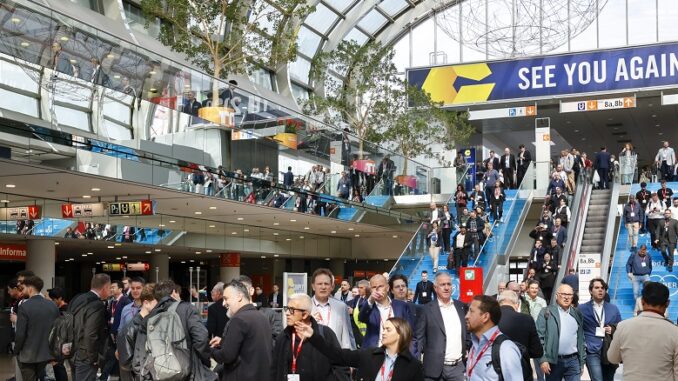
The global packaging and processing industry converged on Düsseldorf last week with unusual intensity, as interpack 2026 wrapped up a seven-day run that organizers called the largest edition in the trade fair’s history.
From May 7 to 13, some 2,804 exhibitors from 65 countries filled the German city’s exhibition grounds, drawing trade visitors from 161 countries. Three-quarters of attendees traveled from outside Germany, with 28% arriving from beyond Europe — a turnout that reflected both the event’s established stature and a broader sense of urgency coursing through an industry navigating regulatory upheaval and shifting supply chain demands. Roughly 100 additional companies exhibited at components, a supplier fair running concurrently.
The mood across the exhibition halls was notably purposeful. Conversations moved quickly from concept to commitment, with many discussions culminating in investment decisions and new project agreements on the floor itself. Attendance was particularly strong from the food and pharmaceutical sectors, two industries facing acute pressure to overhaul their packaging practices amid tightening environmental standards.
Central to this year’s agenda was the European Packaging and Packaging Waste Regulation, a sweeping piece of legislation that industry participants described as a turning point. Rather than treating it as a compliance hurdle, exhibitors used interpack to showcase integrated responses — systems in which materials, machinery and production processes are designed and coordinated in tandem. The approach signals a maturation in how the industry is absorbing regulatory change: not reactively, but architecturally.
Automation, data-driven applications and flexible manufacturing concepts featured prominently across stands, presented not as aspirational technology but as working industrial deployments. Materials innovation drew comparable attention, with exhibitors emphasizing solutions engineered to perform under real-world production conditions while satisfying an evolving regulatory landscape. Across both areas, a recurring theme emerged: the skills required to operate connected, data-intensive systems are themselves becoming a strategic priority.
Beyond the main exhibition floor, a series of forums and programming tracks broadened the conversation. The interpack Spotlight Forum, SAVE FOOD Expert Talks, a Start-up Zone and a Young Talents Day each drew their own audiences, touching on everything from sustainability and diversity to entrepreneurship and workforce development — a reflection of how much the industry’s transformation now extends beyond engineering.
The next interpack is scheduled for 2029, with a specific date to be announced.
Find out more at: https://www.interpack.com/en/