

Good kitchen equipment has a lifespan of eight to ten years and more. When a culinary professional considers the entire costs that a piece of equipment generates during its period of use, then he or she realizes that often less than 50% of the entire costs are allotted to the purchasing price. If a manufacturer guarantees low operation costs, it is therefore usually an indication that his or her equipment uses little energy, water, cleaning agents, or other substances.
But this also suggests that it is less liable to break down and therefore generates very low maintenance costs. All in all, such pieces of equipment or units pollute the environment much less than those, which consume resources on a large scale and are liable to break down. On hand of many discussions, we know that the operational costs, even those of energy use, are evaluated too little. But whoever pays attention to this in his or her investment decision, can lower these costs considerably. A kitchen chef runs his or her kitchen very energy efficient then when he or she uses intelligent systems for energy optimization. These block certain equipment then when the kitchen exceeds a defined consumption peak. Whoever enters the search word “energy optimization” in Google, will find diverse providers of such services. Most cooking processes need water, which the piece of equipment furs up. This results in the heat not being transferred properly. The furred up piece of equipment either uses more energy with the same amount of cooking time, or the cooking processes take longer, whereby these also need more energy. The culinary professionals can solve the problem by using a unit, which pulls the lime out of the water. Moreover, if the equipment which uses the water is connected to the central hot-water supply, the energy consumption lowers again. Therefore, the energy saving and with it the environmental friendly use of equipment and units is decisive, as the following examples show.
 Stoves – the Innovative Classic
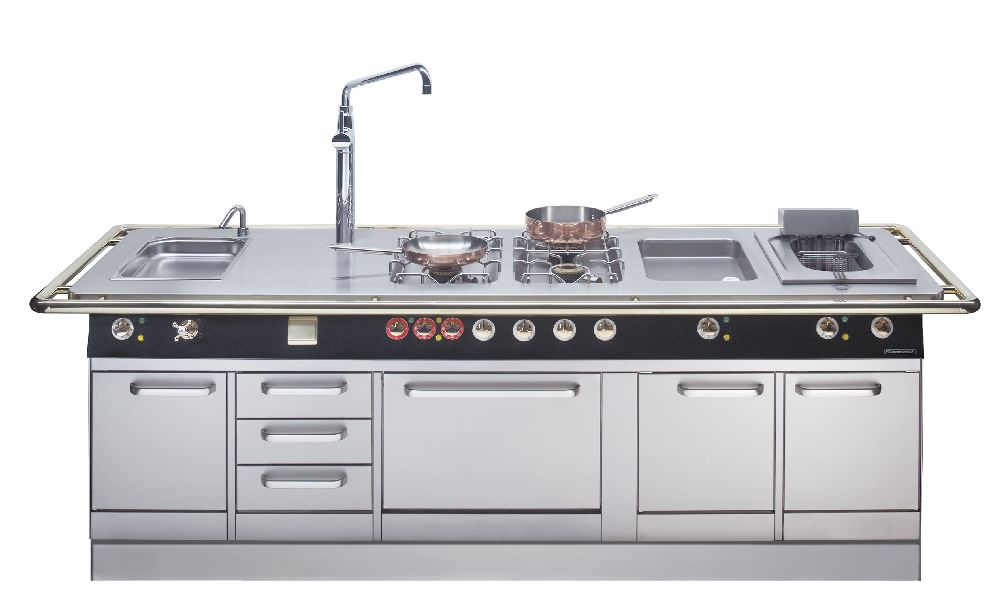
In most kitchens, the stove is the central cooking zone. In the past, the equipment needed a lot of time before it reached the desired temperature. Today it is entirely different. Modern stoves reach their working temperature so quickly that the culinary professionals are able to dispense with the energy-intensive and expensive standby operation.
Cook tops are not always completely in use. Induction and special glass ceramic cook tops recognize which spaces the cookware stands on and divert the energy only there. It is also important that the cookware is fully covered (a well-fitted lid saves up to 25% energy) and tarpaulin lies on the cook top. If the bottoms are uneven, the energy consumption rises by 30%. The materials of the pots and pans also have an influence on the energy consumption. Pans made from chrome steel save more energy than iron pans because they radiate less energy. In comparison to glass ceramic cook tops, induction cook tops can be heated up three times faster and be regulated freely. The cookware radiates less warmth and therefore contributes to a pleasant indoor climate in the kitchen. Cooks are able to cook with gas almost as fast as with induction and the heat can also be regulated continuously variable. But gas has the disadvantage that the heat is concentrated in the middle of the firing point and is not distributed evenly in the cookware.
Hot Air Steamer – Energy Efficient and Usable in Various Ways
Hot air ovens belong to the most modern equipment in a professional kitchen. With them, cooks can fry, bake, roast, steam or barbecue, and have access to programs which have been saved by others, but can of course save his or her own. A further advantage is that they can stock and cook food in the pieces of equipment without transference of flavoring agents or odorous substances. Whoever organizes his or her cooking processes well, can use his or her equipment optimally to capacity. Culinary professionals, for which a hot air oven is not enough, should consider if several smaller pieces of equipment are more economical than a few large ones. From the aspect of energy efficiency, the possibility of letting cooking processes run overnight at low temperatures is very interesting. In this way, cooks use the inexpensive tariff periods. A further effect is that the roasting losses from meat or poultry can be lowered by 18 to 25% with this method, in comparison to conventional methods. Whoever has little space in his or her kitchen can combine a hot air oven with a multifunctional piece of equipment, which combines the function of a tilting frying pan with that of a pressure cooker or cooking kettle and a deep fat fryer. These pieces of equipment work very energy efficient too and reach the desired operational temperature, which can be regulated evenly and graduated finely in the shortest period of time. The cooking times are significantly shorter in these pieces of equipment which are often pressured controlled than if it would be cooked with a conventional piece of equipment.
Refrigeration Related Equipment – of Growing Importance
The demands on refrigeration related technique depends decisively on the production system in the kitchen and the supply rhythm of the suppliers. If they deliver several times during the week, if the cooks processes the wares without a long storage time, if they serve their dishes immediately (cook & serve), and at the same time only a small production surplus arises, then refrigeration equipment with a small capacity is totally sufficient. But more and more culinary professionals produce time-delayed (cool & chill). Due to the fact that they have to rapid chill each batch immediately, they require an efficient rapid cooler/blast chiller and a relatively large capacity in their cold/deep-freeze store. With the decision for or against a new piece of equipment, the energy consumption, the heat insulation, and the performance of the cooling unit plays a very important roll. In any case, the decision-makers have to tailor the capacity of the equipment and cells exactly to their needs because they can only run machines economically that are capacitated well.
 Don’t Fall Below the Minimum Temperature
Deep-frozen products and food have to be stored at -18°, cooled at 4 to 8° C. These products should not be stored under these temperatures because each Celsius degree that is not needed raises the consumption of energy by 4 – 6%. That’s why it is necessary to control the temperatures of the refrigeration device and occasionally also its thermostat. Bylaw (EU 8521/2004), communal feeding and gastronomy operations have to establish HAACP systems. Wrong storage temperatures interfere with the quality of the food and that’s why there is a so-called critical control point, which has to check and document regularly. This guideline also applies to retail trade markets, which offers gastronomical services.
Further Practical Tips for the Workday
Open coolers respectively deep-freeze cells, upright freezers or chests should be closed again as fast as possible. Otherwise, the vaporizer ices up. Thus, it always transfers the cold air poorer and as a result, the energy consumption and its costs increase. Nevertheless, it is not possible to completely avoid ice build up. Professional equipment is partly equipped with modules, which automatically set off the defrosting procedure. If cold stores or upright deep-freezers respectively deep-freeze rooms have to be opened frequently, it makes sense to install the so called air curtain units. These achieve that the cold doesn’t go out and the room temperature cannot come in. The operator can save up to 10% energy like this with cold stores and deep-freeze rooms. Whoever cleans vaporizers and capacitors regularly, can save in comparison to polluted pieces of equipment 5 to 10% of his or her energy costs. Defected door seals can drive up the energy consumption of equipment respectively the cell up to 40%. Pieces of equipment and cells, which are connected to a central cooling unit are the best energy alternative. These should stand on a cool, shadowy, well-aired and dust free place. The more tailored to the needs your temperature is set, the more efficient it will work for you. If it can be lowered by 1° C, then it uses 4% less energy.
 Dishwashing Related Technical Equipment
The people responsible have to check the following points if they would like to organize their dishwashing procedures efficiently:
– The number, type, and turnover frequency of the individual dishes
– The type of return of the dishes to be washed
– Capacity reserves and
– Control as well as the automation of the dishwashing process.
Apart from the optimal cleaning of the dishes to be cleaned, the use of water, energy (including stand by), and cleaning products influence the costs. Very frequently, the rule of thumb is “little water – little energy”. Wherever it is possible, the dishwashing unit should be connected to the central hot water supply. Hard water should be processed in order to prevent lime scale in the equipment.
Professional Business
Like all kitchen technical equipment, the culinary professionals also have to run their dishwashers to capacity well. Only then, are they able to keep their costs low. In the so called “black zone”, in which the dishes arrive that still have to be washed, one has to allow for a sufficiently large storage capacity. With basket dishwashing units, employees washing the dishes have to be able to have access to dishwashing baskets, which are dimensioned optimally. The operator of the unit has to co-ordinate its cleaning program with the level of soil on the dishes, whereby he or she has to pay attention that all of the hygienic demands are met. You shouldn’t lower the operational costs at the expense of the hygiene.