
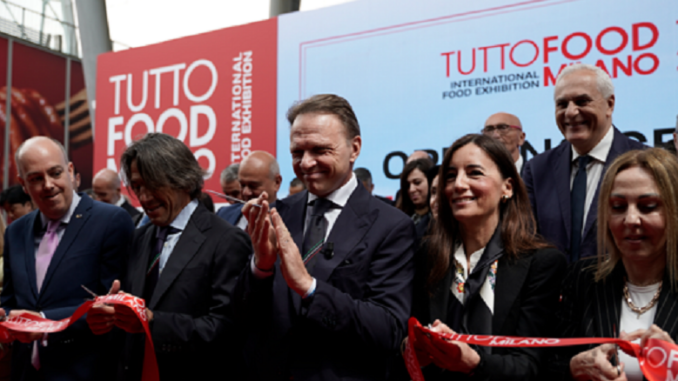
TUTTOFOOD 2026 closed its 2026 edition with record attendance, underscoring growing international demand for Italian and global food products despite mounting geopolitical and economic pressures.
The trade fair, organized for the second consecutive year by Fiere di Parma, attracted 123,000 attendees over four days, including 27,000 international visitors, marking a 30% increase from the 2025 edition. Organizers said the turnout reflected rising interest from food manufacturers, distributors, foodservice operators, importers and buyers seeking new commercial partnerships and expanded market access.
Held in partnership with Fiera Milano and supported internationally by Koelnmesse, organizer of Anuga, the event occupied 10 exhibition halls spanning 82,000 square meters, all fully booked. Exhibition space increased 15% from the prior year, while the number of participating brands rose 20% to 5,000, roughly 30% of which came from outside Italy. The event also hosted 4,000 international buyers.
Antonio Cellie said: “The figures and the unanimously positive feedback from exhibitors, buyers, visitors, and regular attendees of historic global food fairs confirm it: we have filled a space that was still unexpectedly open, creating a completely new international event for the agri-food sector. This event fully reflects Italian know-how in trade fair organization, offering a platform for exhibitors from around the world to connect with international markets, within a fully integrated business ecosystem”.
“Today, trade fairs are no longer just product showcases” Cellie added “They are business hubs where companies assess international demand, develop markets, build commercial relationships, and turn opportunities into tangible economic results. The growth in attendance shows that companies and operators are seeking physical, qualified spaces to navigate a global market that is increasingly fragmented, selective, and competitive.”
The growth in attendance came amid a challenging economic backdrop shaped by geopolitical tensions, tariffs, elevated energy costs, commodity price volatility and shifts in global supply chains.
Organizers said buyers from the US, Latin America, Asia, the Gulf region and several European countries, including France, continued to view Italian food products as premium offerings due to their raw material quality, authenticity and production standards. One European buyer noted that about 70% of its restaurant business depends on Italian products, highlighting the extent to which Italian cuisine has become embedded in global foodservice operations.
Staple categories such as olive oil, balsamic vinegar, flour, pasta, biscuits and chocolate remain difficult to replace in many international markets. Retail and distribution groups including Cencosud and City Super Group identified Italy as their leading European sourcing market for food products.
Industry participants also said Italian food is increasingly viewed as both traditional and innovative, with producers continuing to experiment with new products and culinary concepts aimed at anticipating consumer trends.
Find out more at: https://www.tuttofood.it/en/