
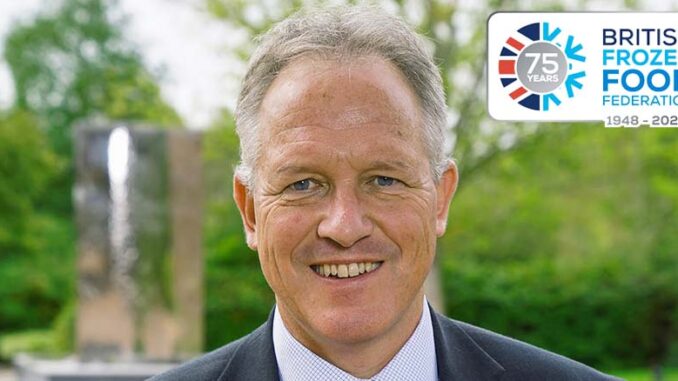
The United Kingdom is certainly one of the most important European markets for frozen food, but recent years have brought several changes and challenges, such as Brexit. So, what are the prospects going forward? I sat down with Rupert Ashby, the CEO of the British Frozen Food Federation (BFFF) to learn more on the state of the industry in the UK.
Frozen Food Europe: First, how have frozen food sales evolved in the UK in 2022?
Rupert Ashby: The most recent figures show that the takings from frozen have increased. I think you’ve got to be careful with that, though, because the tonnage hasn’t increased by as much. So that suggests that a lot of the increased spending on frozen will be food inflation. The cost of living, the cost of energy, the cost of raw materials, etc., etc. And so obviously food has gone up in price. And so that’s now quite a bit of a reason. But there are signs that certain areas of frozen food are growing.
The plant-based side is growing quite a lot. And quite a lot of these sorts of takeaway style meals are being referred to as fakeaways, but where you can get restaurant-grade food, take it home and cook it at home rather than necessarily going out. There’s a sort of increase in those sorts of areas. In terms of food, since the pandemic, frozen food had a boom, obviously during the Covid pandemic, as I’m sure it did all over Europe.
We’ve seen that demand go back to pre-pandemic levels. But again, we’re just starting to see it all picking up again because with the cost of living and the fact that people are wanting to be more careful about how they spend their money, frozen food is increasing there because certainly in this country, you can save quite a bit by buying frozen food. I mean, if you take the top 10 retail items that an average family of four buys, if you buy frozen, you can make up to a 30% saving on your shopping bill. Obviously, everyone will mix and match that. Recently, several of our retailers have been reporting increased footfall in the frozen aisle. So, there’s quite a lot of movement on that.
Frozen Food Europe: What is the status of foodservice and QSR now in the UK?
Rupert Ashby: Foodservice suffered terribly during lockdown. We are now back to everyone being able to eat out. I think one of the challenges for our foodservice, particularly in the big cities, is the new ways of working. Companies tend to be much more flexible now with their working patterns than they were pre-lockdown.
And so, there are quite a few companies that are finding in a big city that from Tuesday to Thursday, they’re very busy and full of people. But on Monday and Friday, there’s a lot less people around to buy the food. And I think that that is really hitting the foodservice. And some are reacting in different ways. Some have moved to looking to have more of their product on a retail basis. So, they’ve almost flipped to more retail and less foodservice.
Others are just simplifying what’s on offer, going for the sort of staples they know people will buy regardless. So almost they’re going for a sort of a slightly more restricted menu of the staples that they know that people will buy. So, they don’t get into trouble with spending a lot of time and effort on products that people don’t buy, because there’s not so many people around. I was in a restaurant just this week in London and it’s taken weeks to get a booking there.
The sad thing for restaurants is if your footfall is down and your electricity has gone up and the food you’re buying has gone up, it’s sort of almost a perfect storm that’s not helping them. There are some that are still struggling. But hopefully, I think once we get through this year, everything will start changing. There are signs that some firms are going back to work. But there are others who are saying, right, no, we are going to close the office on Monday and Friday. And of course, that will have a very long-term effect.
Frozen Food Europe: Which frozen food categories performed best last year?
Rupert Ashby: Certainly, the plant based is growing. It’s a small base, but it is growing. It is growing quite well and ready meals are doing quite well. And the likes of pizzas and pies. Vegetables were slightly down, but that’s also not helped by the fact that last year the harvest here was very difficult. We had extreme heat, not enough rain. And so, yields and production were down and you get issues.
For instance, one member of ours who usually makes a lot of sliced beans for the industry said this year, the beans are too small to slice properly. So, this year you’re getting beans, not sliced beans. Because harvest was down, the crop was much smaller. I know some of our members have land all over Europe as well as here and supplies all over Europe to mitigate against something like that. We’ve got enough vegetables, but there won’t be promotions and things like that because they need to manage the stock.
Frozen Food Europe: In terms of logistics and the supply chain, have there been a lot of moves, any certain directions where companies invested more in 2022?
Rupert Ashby: Our members that are in the logistics side, in general, they are investing, they’re expanding. I have a lot of people who are saying we need more frozen storage. And so, I think it’s an area that’s in demand and will continue to be so. That’s good for the frozen industry. On the other hand, so many other products are frozen that aren’t viewed as frozen. So, Christmas, when you’re eating your biscuit selection pack or your pork pie or things that you’re buying fresh, they were made months ago and frozen and then tempered up for Christmas. And a lot of people don’t really realize that.
And so, I think that also is a case that so much that you buy now has been frozen, even if it’s been frozen sort of minus eight or minus nine rather than your standard minus 18 degrees centigrade. That is how the food industry maintains its supply and keeps you going. I think I sort of changed direction a bit, but I think one area that frozen really has an opportunity in is here. And this will help both people at home who don’t like preparing certain types of things or particularly help with the foodservice industry where they need to manage their costs.
Frozen Food Europe: Could we get your take on the signing of the Northern Ireland Protocol?
Rupert Ashby: I think the main thing is that since Brexit, a lot of our businesses have struggled in terms of trade. And that can be for all sorts of reasons. If they are exported, there’s obviously additional tariffs and things which they didn’t have to deal with before. I was with a member yesterday, their company has a packaging plant in Germany, so, they’ve always done all their packaging.
Now, if they use that packaging plant, they must pay a tariff on that packaging as well as the product coming into the UK. So, they’re now having to subcontract packaging also in the UK as well as in Germany. So, there’s lots of little hidden things that just make life difficult that weren’t there before. I think the reality is that we welcome the conclusion of the negotiations.
We’re pleased that it’s moving along. But with all these things, until we see exactly what’s going to happen, we don’t know the details yet. So, from our point of view, from our members’ point of view, particularly those that have faced difficulties since Brexit, hopefully this is the beginning of a new and exciting chapter. And as frozen food now is becoming more popular and the innovation and new product development is really taking off at the moment, we hope that that gives us an opportunity to trade through Europe as a result of it and obviously solve the Northern Ireland border issue.
Frozen Food Europe: Can you share a few thoughts regarding 2023?
Rupert Ashby: In the UK, we throw away an unbelievable 9.5 million tons of food waste every year. And 70% of that is from households rather than the industry itself. That is something that we need to look at, because it results in about 10% of our carbon emissions. And so, if we could reduce food waste, it would make such a difference to our carbon output. Of course, frozen food helps with that because it doesn’t get thrown away. You take out what you need, you cook it. You very rarely throw frozen food away because it sits there in the freezer. If you forget about it, it doesn’t matter because it’s not going off.
I think frozen has a very important part to play in sustainable food future in the years to come. So, I think that’s another thing through 2023 and beyond is that the frozen industry can really help the UK move to a sort of a more sustainable approach and reduce its carbon. Every September we will run frozen food week. Last year was the first one we did, and the idea about it was twofold, really. It was to promote frozen food and show how nutritious and good it was and what all the options were. It also highlighted the fact that we all need to reduce our food waste and we can really help the planet by doing that. And this is the role that frozen plays.
It’s our role all year round, but in terms of a sort of big promotion piece in September this coming year, we’ll be doing a frozen food week again and pushing all those points yet again.