

The frozen food market in the UK did well to bounce back from a disastrous 2013, when sales were significantly affected by the horsemeat scandal, which forced a number of product recalls for lucrative goods within the market, such as frozen ready meals and frozen processed meat.
The market was seriously hampered by the decline of frozen ready meals in 2013 which, according to Euromonitor International, contribute around 13% of the UK’s frozen food market. In fact, the UK frozen food market, which is one of the most profitable of its kind in Western Europe, performed steadily in 2014. Growth was stimulated by low prices compared to chilled counterparts and a recovery in demand as a result of increased promotional activity and a restoration of trust from the public.
 Current trends
Frozen food within the UK has benefited from a range of trends. The European debt crisis, which particularly affected the country, seriously favored growth in frozen goods, which are cheaper than their chilled and fresh counterparts. This is not the only way the crash has helped frozen food, which has many practical advantages over chilled rivals. Consumers have become more concerned about the amount of waste they produce, and frozen food is useful in restricting the amount of waste produced. This has resulted in a number of private label retailers increasing the amount of frozen processed vegetables that they sell – Sainsbury’s, for example, now sells a range of herbs, spices and roots, such as frozen chopped ginger and frozen chopped garlic, which will appeal to consumers who use these products, but not frequently enough to warrant purchasing fresh produce. For time–strapped consumers who do not seek to cook with raw ingredients, frozen ready meals and frozen pizzas are cheaper than their chilled counterparts and, many frozen food manufacturers would argue, equal in quality.
Quality has become another significant battleground for frozen food in its battle against chilled goods.
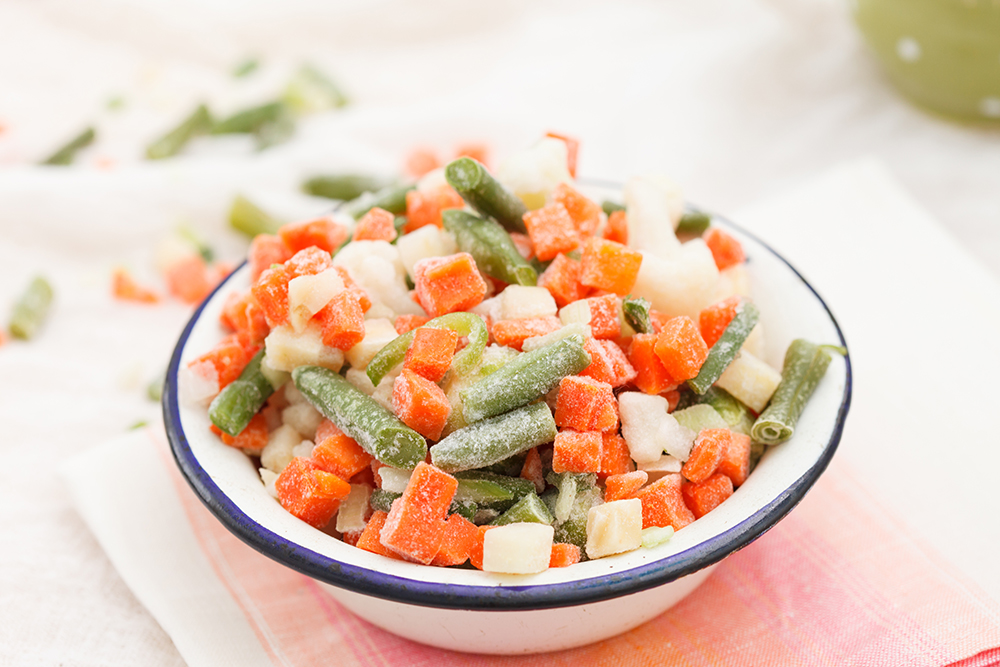
Frozen food, rightly or wrongly, fares worse than chilled food when it comes to perceptions of quality of content. A large proportion of the general public perceive chilled and fresh vegetables, for example, to be fresher than their frozen counterparts, offering superior quality and taste. This comes at a time when messages regarding quality, value for money and health continue to resonate, as consumers are experiencing a lower quality of life than before the economic recession. This, again, has helped products such as frozen processed vegetables perform well over the last five years – value sales grew by 3% over this time period and 2% in volume terms; frozen pizzas grew by 4% in both value and volume terms. Added-value frozen vegetables have also proved popular, with mixed vegetable bags becoming more widespread within stores.
Many companies, such as Bird’s Eye, advertised the freshness of their products, as well as their high quality. This was the case when it launched its “Inspirations” product range, which sells premium fish and chicken products. Here, then, we can see companies try to appeal to a wide range of consumers with frozen food products. On the one hand, they appeal to less wealthy consumers who have lower disposable incomes by frequently discounting products in stores; on the other hand, companies such as Bird’s Eye look to appeal to wealthier customers who have more money to spend on goods. It is a different message to each demographic – they communicate quality and cost.
 Producers’ strategies
In terms of value sales, several categories performed well in 2014. Frozen processed potatoes, for example, grew by 5% to reach sales of GBP822m. Frozen potato products is a consolidated market with a large number of branded manufacturers operating. The industry was seriously boosted by a range of these industry stalwarts introducing a number of successful new products. McCain, the leading brand in frozen potatoes, launched a new range of oven baked chips that are able to be cooked in just five minutes. It also continued to experience success with its “Ready Baked” jacket potato products, which the company has been extremely effective in advertising through television and billboard campaigns; “Ready Baked” grew by 6% in 2014 to achieve sales of GBP24 million. In addition to launching its premium fish and chicken ranges, Bird’s Eye was particularly creative, as it launched Bird’s Eye Mashtags. The products were aimed at children and contained social media related potato shapes. The product achieved strong sales after its launch, with Euromonitor estimating that the brand made GBP5m in its first year alone. Aunt Bessie’s was also extremely busy, introducing new products to its potato range and consolidating its market share as a result.
While companies kept busy and performance appears positive, the reality is far different. Although value sales went up, consumption of frozen potatoes decreased by 2% in volume terms in 2014, to reach 541,000 tonnes.
This suggests value growth was artificially raised by unit price increases, which increased by 7% this year. Unit prices were forced up for three reasons: there was an increase as a result of increased commodity price inflation as well as increasing energy prices, but an extremely poor crop yield was the most significant factor in driving prices upwards. Manufacturers are therefore faced with a choice – profits or sales – and the majority appear to have sacrificed sales for the sake of profits. Manufacturers will be hoping for increased crop yields over the next five years, but more uncertain climatic conditions make it hard to warrant such optimism – Euromonitor estimates that volume sales will remain flat over that period, resulting in a decrease in consumption per capita.
Health is becoming an important battleground, with more and more consumers becoming aware of the importance of a balanced diet. Many food companies, regulators and policymakers talk of the need to offer consumers a wider choice of products, which should involve increasing the amount of health and wellness goods available in stores. This applies to frozen food as much as it does to other food types, and there have been a number of products launched in 2014 that demonstrate an increased focus on promoting healthy goods. Bird’s Eye, for example, has been particularly keen to promote its new “Steamfresh” range, which is part of an effort by the company for all of its new product developments aiming to be healthier than current products by 2020. The Steamfresh range is essentially a range of added-value frozen vegetable and pasta products, but it rebrands Bird’s Eye’s frozen vegetables range and raises consumer awareness at a time when they are looking to purchase more private label goods. Having said this, there is cause for some skepticism, as no health claims are actually published on Steamfresh products.
 Certainly, there is a market in frozen food for health and wellness products; that is, products that have active health benefits for consumers. One only has to look at Heinz’s Weightwatchers brand – which, with sales of GBP50m, is one of the leading frozen ready meals brands in the UK – to see that there is an audience for products that reduce fat, salt, sugar and other ingredients that consumers are becoming more reluctant to consume. There are also a number of free from products where frozen has an advantage over its competitors. For example, there are a number of gluten-free manufacturers that have strong frozen food portfolios. This is particularly useful at present, as gluten-free diets are currently in.
Compared to other packaged food goods, such as chilled foods, the frozen food industry has a fairly equal balance between private label goods, which are sold by retailers, and branded products. Euromonitor estimates that private label goods accounted for 45% of all frozen food sales in 2014, compared with 70% of all chilled processed food sales. Clearly, this is the result of stronger branding by frozen food competitors – they offer something genuinely different from their private label counterparts.
What’s next?
Ultimately, frozen food could perform better. The market is being flattered by soaring unit prices for key products, such as processed potatoes. In fact, there is no real increase in consumption, with flat volume growth in 2014 largely correlating to the minimal growth the industry has experienced in the previous five. As a result, despite an increase in sales for the largest brands, there is still cause for concern within the industry. This could be exacerbated by the changing retail environment, which could see brands sidelined as discounters’ private label brands increase their share of sales. These companies will have to work hard in order to secure more sales, but they have a good track record of product development, which should help them over the next five years.
Despite a slight increase in volumes, it will be difficult for the frozen food market to generate significantly more sales or consumption over this time period. Demands and influences on consumer purchasing habits are relatively locked down in the UK – to an extent the market is somewhat commoditised, making it difficult to achieve any substantial growth. Given this fact, with little evolution in the market, companies need to emphasise the benefits of frozen food over its counterparts. This will involve more innovation, with a key focus on healthier products, and bringing more attention to frozen food aisles via more eye-catching packaging and heavier in-store advertising.