
The ice cream market in Western Europe suffered a double blow during 2012. Not only does the region’s economic situation remain stubbornly weak (latest forecasts by the IMF, for example, suggest that the EU economy may contract by 0.2% during the current year), but there was no sign of a return to the warm summer weather experienced a decade ago in many parts of the continent. From a climate perspective, the UK experienced its wettest summer in more than a century, with June the wettest on record. As a result, consumption of ice cream declined in many parts of Europe.
Overview
Hardest hit in northerly markets such as the UK was the impulse sector. As a result, manufacturers have been looking to the take-home sector for growth, with many consumers trading up to luxury and/or premium ice cream in spite of the adverse economic situation. In the UK, for example, the luxury ice cream market grew by 7% to GBP146m in the year ending September 2012, driven by brand activity and the suitability of ice cream as a sharing product for social evenings spent in the home. Despite the difficulties facing the market at present, ice cream remains a popular and frequent purchase for many European consumers. This is particularly the case in the Scandinavian countries – for example, 97% of Danes claim to eat ice cream during the course of a typical year, a figure which compares with 96% for Finland, 92% for Sweden and 87% for Norway. Further south, more than 60% of people in the UK are thought to treat themselves with ice cream on a frequent basis, whereas just over a fifth (22%) of Spanish consumers are thought to regularly buy into the category.
 Western European markets
In value terms, the Western European ice cream market (including the UK, France, Germany, Italy, Spain, Ireland and the Benelux countries) was worth an estimated EUR9.96bn in 2011/2012, a figure which has shrunk during the last year as a result of the weak economic situation across the region. On a global basis, value sales of ice cream are thought to be worth up to USD85bn. Italy represents Western Europe’s largest ice cream market in value terms, with sales worth EUR2.65bn, ahead of Germany, France and the UK. However, it should be noted that these figures refer to industrially-manufactured ice cream alone, and exclude sales via artisanal channels. The country has one of the world’s largest artisanal ice cream sector, made up of over 30,000 specialist ice cream parlours. Out of the countries under review, per capita consumption of ice cream is highest in Ireland, at 9.5 liters. This figure falls to 9 liters in Belgium and 8.9 liters in the Netherlands, but is lowest in Italy, at less than 4 liters. Per capita consumption of ice cream for these European countries ranks below many of the Scandinavian countries, with a figure of more than 14 liters existing in Finland. Sales of ice cream in Western Europe are most commonly segmented into take-home and impulse channels. The take-home sector is largely comprised of tubs and multipacks, whilst the impulse sector refers to products purchased for immediate consumption. It is the latter which has borne the brunt of the cooler summers experienced in many parts of Europe lately, although it remains an important feature of the market. The share of the market taken by the taken-home sector ranges from over half in the UK and Germany to more than 70% in France.
Major Suppliers
Unilever leads the Western European ice cream market, and accounts for 20% of global sales. The company operates 11 manufacturing sites across Europe, including major facilities in the UK, Germany, France and Italy. Its market share ranges from almost 40% in the UK to 30% in Germany, rising to 70% in Ireland. Its leading brands include Magnum, Ben & Jerry’s, Cornetto, Carte d’Or and Solero. The Magnum brand remains a core part of Unilever’s strategy, and is one of the largest within the European ice cream market. It is now available in 50 countries, and was launched in the US and Canada during 2011. Within the last year, the company introduced a new Facebook app titled ‘Magnum Mini Moments’, which enabled users to personalize clips from Paramount Pictures films. Furthermore, the brand was extended into the tubs sector for the first time during the autumn of 2012. Positioned at the luxury end of the market, the tubs were launched in Chocolate & Vanilla and Chocolate & Chocolate flavors.
 Unilever
Known worldwide as the third largest consumer goods company, Unilever, the Anglo-Dutch multinational company is at this point the largest producer of ice cream around the world. The food giant has also continued to extend its various brands with new flavor varieties. During the second half of 2012, for example, it added a new Winter Berry Brownie flavor to its Ben & Jerry’s range in the UK, which contained chocolate brownie pieces and fruit swirls. In Germany, new flavor variants appeared as part of the company’s Langnese Cremissimo range, which was launched in 2011 and carried a film theme. The new flavors launched in February 2012 were Casablanca (white chocolate and creamy nougat ice cream with a chocolate nut sauce and almond pieces) and Romeo & Julia, which featured blueberries and dark and white chocolate hearts. Returning to the UK, the Carte d’Or range has also been extended within the last year with new flavors, examples of which have included Strawberry with Strawberry Pieces and Amaretto, Vanilla & Chocolate. There have also been efforts to move the Carte d’Or range further upmarket – during September 2012; a new luxury ice cream range appeared under the Signature label. Flavors included Crème Brulee, Tarte aux Pommes and Fondant au Chocolat.
Nestlé
One of Unilever’s closest rivals is Nestlé, which is present in many parts of Europe and accounts for up to a fifth of sales in France and Spain. In France, the company leads the ice cream cones sector with a 19% share, whilst it is the leading branded player in the children’s ice cream market, accounting for almost a quarter (24%) of sales. Nestlé’s Extreme brand accounts for a leading 53% share of the French market for ice cream cones, and was extended in April 2012 with new American-style varieties in Vanilla Chocolate Fudge and Coffee & Cream flavors. Also part of Nestlé is the Schöller ice cream business, which is present in Germany. Schöller accounts for almost 10% of the German ice cream market, and includes hand-held cones such as Smarties and Bum Bum. The company also owns the premium Mövenpick brand, which is available in European countries such as Switzerland, France, the UK, Germany and Finland, as well as further afield. During the autumn of 2012, Nestlé announced it was to open its first Mövenpick ice cream boutique in Russia.
The Haagen-Dazs brand
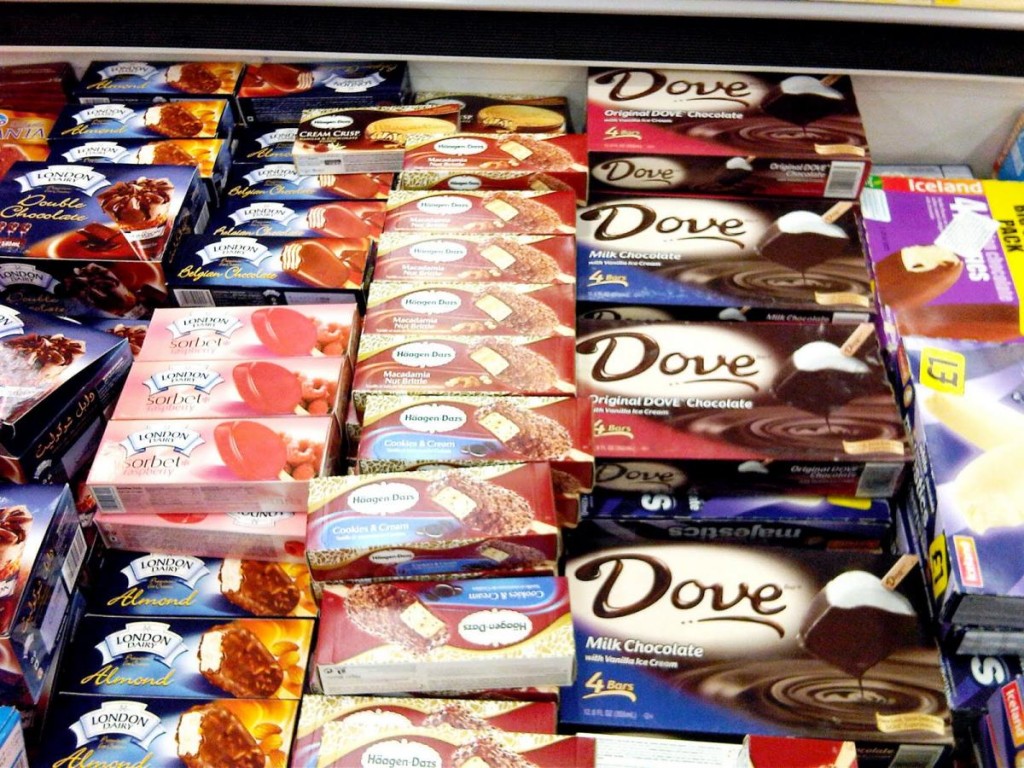
This brand is owned by General Mills, competes at the premium end of the market. UK sales of the brand are currently worth in the region of GBP40m, whilst Haagen-Dazs is the third largest supplier in the French ice cream market, with a 10% share. In the French market for premium ice cream packaged in pots, its share increases to 70%. During 2012, the UK Secret Sensations range (i.e. premium ice cream with a saucy centre) was extended with a new Meringue & Raspberry Fondant flavor .
 R & R Ice Cream
The largest supplier to the European own-label market is R & R Ice Cream, which accounts for 10% of ice cream sales in the UK. At the time of writing, owners Oaktree Capital are believed to have put an 82% stake in the business up for sale. Potential bidders are thought to include private equity firms such as Bain Capital and Apax Partners, and any sale may fetch up to USD1bn. R & R itself has made a number of acquisitions in recent years – during the summer of 2012, for example, it took control of Eskigal (Italy’s leading supplier of ice cream to the own-label sector) for EUR77m. This was followed at the start of 2013 with the acquisition of the Yoomoo brand of frozen yoghurt. In addition to its own-label business, the company also supplies ice cream brands such as Rolo, Toffee Crisp and Rowntree’s Fruit Pastilles. Other suppliers within the European ice cream market include the likes of Mars (which is present in countries such as the UK and France, and is especially strong in sectors like take-home multipacks and wrapped impulse products) and Frederick’s Dairies. The latter supplies Cadbury branded ice cream products – examples of which include Crème Egg and Buttons – as well as Vimto and Del Monte ice cream.