
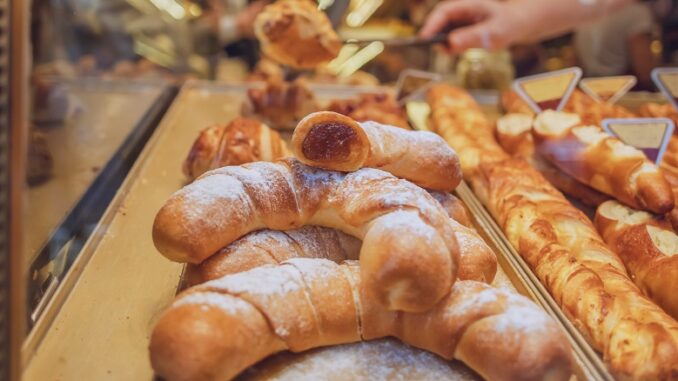
A burger without a patty – unimaginable! There are no bakery snacks without bread or buns. Bakery goods are widely available in almost all segments of the eating-out-of-home market.
What’s more, it is quite a unique world with its own demanding technical processes – now often accessible at the touch of a button on a touch screen. Complex technology can be that easy to use at the point of sale. By Dieter Mailänder, Redaktionsbüro Dieter Mailänder
Cooking, frying, and baking are the three basic techniques available for preparing food, even in the eating-out-of-home market. Specifically, this means that the professionals on site cook part of their choice of food on the cook-top (cooking in liquid).Then they fry another part (browning with fat, sometimes also with liquid on the cook-top as well or roast it in the oven at temperatures between 60 and 200° C; we do not take deep-frying processes into consideration here).
What remains are products made from dough which are baked in dry heat in the oven between 120 and 250° C (dry brown cooking).
The boundaries between these different cooking techniques are not clear-cut. In bakeries and commercial kitchens, professional equipment, for instance, offer the option of supplying air to baking or cooking chambers, allowing the moisture content to be flexibly adjusted. This process, known as steam injection, plays a key role in many baking and re-baking processes.
When exposed to moist air, dough pieces made from yeast dough, for example, develop a crispier and more browned crust, a finer sheen, and greater volume. Such bakery processes are carried out in all industrial and artisanal production facilities. In greatly simplified form, they can be found in the out-of-home market, bakery shops in grocery stores, in (chain) restaurants, and in catering for employees, patients, students, or overnight guests too. Apart from the hotel industry, out-of-home professionals often process their bakery goods baked on site into bakery snacks that their customers consume immediately or somewhere else.
A Wide Range of Baking Processes
Europe is the world’s most prominent hotspot for baked goods, even though their importance varies considerably from country to country. The range of products is difficult to grasp, but the variety of dough-based products is more than impressive. The different types of dough are characteristic. As a layman, you may be familiar with batter (e.g., muffins), sponge cake batter (e.g., pastries), shortcrust pastry (e.g., sheet cakes), yeast dough (e.g., pizza), or puff pastry (e.g., baklava).
Even if you don’t find all types of dough in every bakery or professional kitchen, there is still a wide range that professionals use in their businesses – at least in the final stage. This is because they often purchase pre-baked or finished dough pieces from industrial producers, which are (vacuum)-cooled or deep-frozen. They then bake these partially or fully baked dough pieces either completely, finish them or regenerate them as needed.
These final process steps require special devices with versatile programs. They should be intuitive to use i.e., largely irrespective of the language skills of the operators. The more self-explanatory the symbols used to operate the device, the greater the likelihood of achieving the desired result. In many cases, manufacturers provide complete programs that operators can obtain at the touch of a button.
Combi Steamers – a Success Story
Refrigeration technology is a highly differential subject in bakeries as well as in commercial kitchens. Considering this from a distance, there appears to be a certain similarity between interrupting fermentation in the baking process and cook & chill in the cooking process. In the first case, the process of fermenting the dough, which serves to loosen it, is interrupted; in the second, the cooking of the food is stopped prematurely. In both cases, the aim is to achieve a shelf life for two to three days for the largely but not completely, finished baked goods or dishes.
However, the equipment differs considerably. Equipment that can be used to carry out complex baking processes is relatively rare in businesses in the out-of home market – beyond bakeries. The combi steamer has been the main piece of equipment for many years here. Its first predecessors came onto the market in the late 1960s; in 1976, the long-standing and current global leader Rational presented its first device.
Since then, all suppliers have increasingly refined their technology. Their throughput in the market is a unique success story. Initially, baking processes were not on the table in the out-of-home market. It only developed once manufacturers refined their technologies for the controlled supply and removal of air and moisture significantly and optimized their air swirling in their devices by using air wheels.
These step-by-step optimization processes are some of the most groundbreaking developments that have led to the current status quo; they have ultimately made baking and reheating processes possible. Sensor technology plays a decisive role here, as it allows individual stages of cooking and baking to be analyzed and monitored by the program. Even separate trays can be controlled individually.
This feature is always useful when different baked goods are supposed to be regenerated at the same time. Being that the process result also depends on the density of the tray loading as well as the frequency of the door openings and the associated heat loss, the sensor technology also monitors these parameters and signals when the products on the tray are ready.
To read the entire article, please access your complimentary e-copy of Frozen Food Europe May-June, 2025 issue here.