

There are very few areas of food regulation that have not been subject to review in the last few years. From 13 December 2014, the latest of those changes – the recasting of the entire food labeling regime across Europe – will change with the European Union (EU) Food Information to Consumers Regulation (FIC) coming into force.
FIC is a law that will replace and harmonize food labeling regulation across the EU. It takes the place of the existing law that required member states to set their own rules meeting certain minimum standards. In the UK, those rules were found in the Food Labeling Regulations (1996) which, after almost 20 years, are now very familiar and embedded within the UK industry.
Many may ask – why change the rules if they were not broken? The answer in part comes from the change in the way that the EU likes to regulate. Historically, the EU preferred to set the minimum standard and it was for the member state to decide exactly how to regulate provided it met those minimum standards.
However, the EU now wants to set exact, rather than minimum, standards. The rules that it creates come into force automatically, without additional domestic legislation and help business, as well as trade by removing the ambiguity of 28 member states implementing laws differently.
 What do I need to know?
While the topic areas covered by FIC will come as no surprise and many of the changes are relatively subtle, there are a number of key changes that will apply to all food manufacturers. We discuss a few of the most significant changes next.
Mandatory information
FIC requires that certain mandatory information is provided on all pre-packed foods, this includes:
• The name of the food
• The list of ingredients
• Any ingredient or processing aid causing allergies or intolerances used in the manufacture or preparation of a food and still present in the finished product, even if in an altered form
• The quantity of certain ingredients or categories of ingredients
• The net quantity of the food
• The date of minimum durability or the ‘use by’ date
• Any special storage conditions and/or conditions of use
• The name or business name and address of the food business operator
• The country of origin or place of provenance for certain products
• Instructions for use where it would be difficult to make appropriate use of the food in the absence of such instructions
• A nutritional declaration (although this obligation doesn’t become mandatory until 2016 unless businesses chose to voluntarily to apply a declaration)
This requirement is a significant extension from the current regime – the obligation to provide country of origin information is extended and nutrition declarations are made mandatory.
Nutritional information
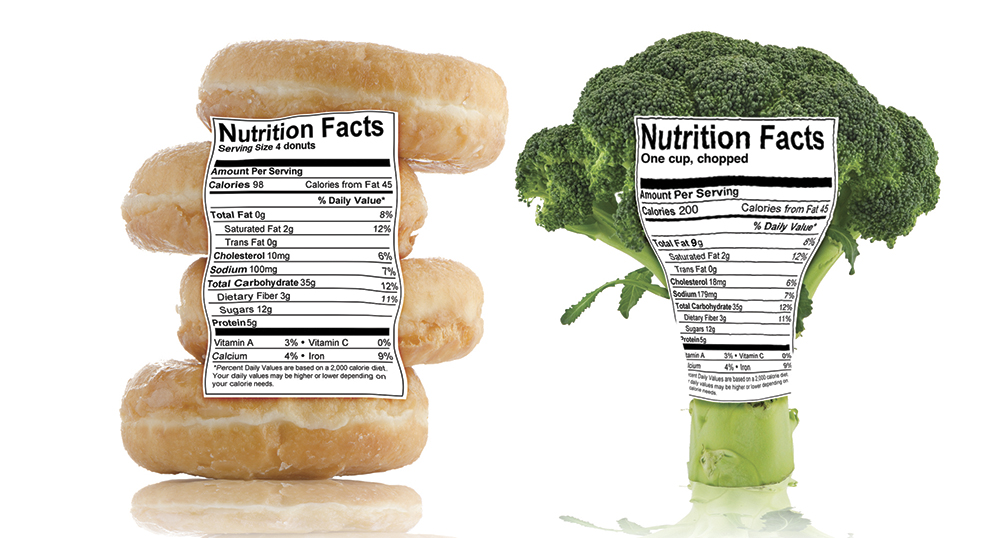
The nutritional information to be included on pack has changed. Not only is the list of nutrients included slightly different, for example, fiber declarations are not obligatory, there is also the move from the use of the term ‘sodium’ to the term ‘salt’ in the declaration.
The nutritional information required to appear on the packaging or labelling is:
• Energy, • Fat, • Saturates, •Carbohydrates, • Sugar, •Protein, • Salt
This information must appear in the same area of the label or packaging and must be laid out in a tabular form, which differs slightly to what would be done under the current regime. However, if there is not enough space for this, then the information can be laid out in a linear format.
 Minimum font size
One of the biggest practical challenges is that the mandatory information on pack must be a particular size. Under the current regime, the requirement is that the information is legible. FIC goes further by defining what that actually means.
It requires that all mandatory information must be at least 1.2mm in height, which may create space conflicts between regulatory compliance and marketing messages – the must have versus the nice-to-have messages.
There are exceptions for smaller packages where the largest face is under 80cm² where the required font size is reduced to 0.9mm and for packaging that is less than 10cm², where the information required is less.
This change means that in some cases a complete redesign of the packaging will be required in order to ensure that all of the necessary information is provided.
Country of origin information
The country of origin must be provided in the following circumstances:
• Where this is required by specific EU legislation (e.g. beef, olive oil, honey, etc.)
• For swine meat, sheep meat, goat meat (fresh, chilled or frozen)
• Where failure to indicate the country of origin might mislead the consumer
Changes to the way that allergen information is provided
The rules in FIC are prescriptive. How allergens must be declared are some of the Regulations’ more contentious changes. The days of clear allergen boxes that are separately placed on the label are gone. While this practice was well known in the UK, it was not widely adopted across the EU and therefore does not feature in FIC.
Instead, each allergen ingredient must be indicated in the list of ingredients and emphasized through a typeset or color that distinguishes it. For the UK public, this is a significant change as we are conditioned to looking for allergen information outside of the ingredients list. When the name of the food clearly refers to the substance causing allergies, such as ‘peanuts’, it is not necessary to label the concerned substance.
Frozen food changes
FIC deals with frozen food in a way that the existing regime does not. There are several points in particular that frozen food manufacturers should be aware of to ensure their products will be fully compliant:
Freezing date
All products that have been frozen or refrozen are required to specify this clearly on-pack with date information. If a food product has been frozen more than once, the first freezing date must be indicated. This is mandatory only on the labelling of pre-packed frozen meat, frozen meat preparations and frozen unprocessed fishery products. However, individual countries may decide to extend this requirement to non-prepacked ones.
The date of freezing or the date of first freezing must be indicated as follows:
The words ‘Frozen on…’, followed by the day, the month and the year in that order
The name of the food
In cases where its omission may mislead the consumer, food business operators must ensure that the name of the food includes information on the physical condition of the food or the specific treatment it has undergone. For example, if it has been refrozen, freeze-dried or quick-frozen.
Foods that have been frozen or quick-frozen before sale and are then sold defrosted must carry the name of the food together with the term ‘defrosted’ for example, ‘defrosted salmon’.
Glazed frozen food
Where a frozen food or quick frozen food has been glazed, the net weight should not include the glaze itself, therefore the net weight of the glazed food will be identical to its drained net weight.
 Further changes coming
In addition to these labelling changes, the EU may create a wide range of further rules. These are known as delegated acts that sit under the FIC. There are a number of delegated acts that the EU is obliged to make and others where there is optional.
To date, delegated acts have been produced to provide further rules on country of origin for fresh, chilled and frozen meat of swine, sheep, goats and poultry. This is a space worth watching to ensure that new obligations are not missed.
Brave new enforcement world
FIC does not prescribe an enforcement regime, but member states may opt to implement their own national enforcement regime. The UK’s regulations are yet to come into force, although a draft has been consulted on and will be known as the Food Information to Consumers Regulations. The latest expectation is that the Regulations will be available in mid-June.
While we have not seen the final Regulation, the draft creates a brave new world of enforcement as it does not specify a wide range of offences as is the case with the current labelling law. It creates only one offence relating to allergens and requires all other matters to be dealt with via Improvement Notices – a written warning stating what the business must do to comply with the law. Failure to meet the requirements of the Improvement Notice would be an offence.
This does not mean that all other issues are decriminalized; enforcers will still be able to prosecute for issues such as selling food after its use by date, but to do so would need to use other legislation, such as the prohibition on selling unsafe food, to prosecute offenders.
Next steps
Most of the FIC changes come into force on 13 December 2014, so frozen food manufacturers should begin preparing accordingly. While December is a number of months away, a significant lead time is required to ensure that all product labels are printed in time. The requirements for mandatory nutrition labeling don’t come into force until 2016; however, if nutrition labeling is voluntarily applied then it must comply with the FIC.
As the deadline gets closer there are delegated acts that are yet to come into force which means in some areas the rules may change further. To some extent this might penalize early adopters, but it is far better to have already made the majority of the changes and be ready to tweak as the additional rules come into force. In any case there is likely to be further transition provisions.
As far as general food labeling is concerned, all food labels must be changed in time for the December deadline – so the time to act is now.