
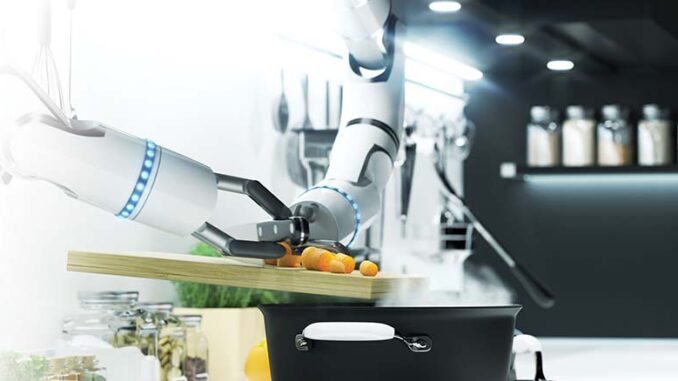
Artificial intelligence, digitalization and networking have always been connected. Today, however, they are almost inextricably intertwined and offer interesting but not always risk-free opportunities even for the operations of professional kitchens.
The potential of this trio is still long away from being tapped, but a young man is already opening a new window. By Dieter Mailänder, Redaktionsburo Dieter Mailänder
At the end of 2023, three students achieved a remarkable breakthrough. With the help of AI, they were able to make parts of the text of a 2000-year-old piece of parchment readable again that was completely charred during the eruption of the central Italian volcano Vesuvius in 79 BC. This success is linked to the hope that one day the entire scroll will be readable again and with it many other documents that are currently still considered to be destroyed.
What does this information have to do with the out-of-home market? There is nothing at the first glance, but at the second glance. This is because it gives all of us a glimpse of all the possibilities of this technology in the future – even in our industry.
Tightly Knit
Artificial intelligence (AI), digitalization, and networking are closely intertwined as the three following examples show:
• Robots
Restaurateurs program such devices to have the dishes brought to their guests in their restaurants. If several such devices are running in an operation, they can be networked and then used flexibly. In nursing homes and hospitals, robot nurses can relieve the burden on the staff, for instance, by taking over strenuous work like lifting patients. But there are already robots for social functions like communicating, playing, or interacting too. Innovative voice control models (see below) will open previously unthinkable applications in the future, including in professional kitchens.
• Unmanned trolleys, which move around a site without rails, deliver food. Catering facilities at large plants thus supply employees in remote areas who cannot quickly reach a company restaurant.
• Software Updates
For several years now, software for commercial kitchen appliances can be updated across locations, in as much as the devices are connected accordingly. For example, recipes or preparation instructions can be uploaded at the same time – even worldwide if necessary. However, professionals think much further ahead when it comes to networking.
• Simplified Planning of New Commercial Kitchens
Not only future-orientated chefs use various IT features. Even architects and planners of professional kitchens are increasingly using building information modeling (BIM) for their networked planning and building processes. This software processes digital data of commercial kitchen appliances, among others, to optimize the workflow of new operations.
Networking – What For?
The so-called kitchen control systems monitor the equipment of innovative, new, but also existing kitchens, especially their energy consumption. They read out consumption data and HACCP relevant test results and process this information for statistics and management information. Kiconn and Check Cloud are two such platforms.
Mandatory requirements for such platforms are data interfaces accepted by manufacturers networked with each other whose producers store them in the software of their devices. The platform operators check and confirm to the manufacturers that the “device – platform” data transfer works.
The benefits of such control systems are many and varied, as the following examples show:
• Cost reduction by
• Optimizing procurement, primarily from energy and in the future perhaps also from water, which is also becoming temporarily scarce time and again in Central and
• Southern Europe (capping load peaks)
• Preventive maintenance (management of maintenance and service tasks, avoiding unscheduled repair and service work)
• Tracking the food distribution equipment (containers and trolleys) along the entire supply chain
• The automation of regularly occurring routine tasks – for example, complete documentation for regulatory authorities and management
• Optimization of the workflow
The German standard for this standardization has been in place for five years. It was revised in 2021 (DIN/TS 18898). In the further developed form, it includes 16 different device classes. Since then, refrigeration equipment can also be integrated into open (non-proprietary) networking among various manufacturers and networking across devices. It is also possible to use the interface as a gateway or a cloud communication interface.
The International Perspective
Of course, the above-mentioned standard also has an international dimension. The people responsible have developed (built) it into the OPC United Architecture (OPC UA). It is also available as the Companion Specification of the OPC Foundation. That’s why their interface can be used transnationally. The process of implementing this takes time– a lot of time. The more frequently kitchen professionals implement such control systems and therefore ask for appliances with these interfaces, the more manufacturers will be forced to incorporate them into their appliances.
A Platform of Confidence
The process to develop such platforms has been going on since the 2000’s. At first, hardly any manufacturers were prepared to have their device data read out. The hurdle of placing them on an independent platform was even higher – the manufacturers feared that their data would be misused.
It took a great deal of persistent international persuasion to gradually build up industry-wide acceptance for such platforms and standards, not only in our sector, but in almost all sectors and not only in Germany, but in other countries too. But in the meantime, it is accepted because the manufacturers are convinced and trust that their data is safe on them.
Caution is as Important as Trust
But what about devices manufactured in countries whose institutions and state-sponsored parties reserve the right to potentially access all data from administrative and commercial enterprises? Doesn’t one have to assume with them that they deposit hidden features in your software to spy out information and forward it to government agencies or the party who analyze it? Shouldn’t one even consider the scenario that they are not only tapping into the data of their own devices of their customer, but also that of other users of the platform, who are not among their customers?
Previous experience forces us to assume all of this. One Far Eastern country even obliges companies to potentially cooperate with its secret service and to establish and tolerate party cells (note: there are even mandatory obligations to cooperate in the US).
But are these all arguments against cross-platforms for manufacturers, including those of kitchen control systems? No! No one can isolate themselves. One must live with these circumstances. Presumably there is only one way: the manufacturers must be as sensitive as diviner’s rods. They must secure their software in the best possible way, not only against cyber-attacks, but also against state-initiated spy software. If you discover weak spots, then ultra-fast measures must be taken. Then they will be able to cover this issue, probably not completely, but to a considerable extent. The somewhat bitter realization is more is not possible today; more will not be possible in the future either.
A Look into the Future
When it comes to the question of how the development will continue, the focus returns to a young man, the 31-year-old Jerry Yue, the founder and CEO of the US American company, Brain Technologies. At the Mobile World Congress in Barcelona in February 2024, he introduced the prototype of a cell phone that totally dispenses with APPS and processes voice commands with AI.
The so-called large language models (LLM) are the basis, such as those used in the chatbot ChatGPT. While the previous LLMs communicate, but above all, produce texts, Yue’s will go further: his LLMs are supposed to book flights, place orders, and much more. In other words, the US Chinese-born wants to place his AI above those of the others, so to speak, meaning that his superior software should subordinate the others and let them work for them.
Should the prototype of the cell phone from Brain Technologies be ready for series production, it is highly likely that this technology will also be transferred to other applications. It will also arrive in our industry soon. Then equipment won’t be controlled by APPS anymore, but by Multilanguage voice commands. Recipes, preparation, or operating instructions, which are stored in many languages in the clouds, can then be called up quickly and reliably with the help of AI, even by employees with little knowledge of the language.
Training or instructing foreign-language employees could become much easier in the future than presently. Perhaps staffing problems can be softened up in this way in several European countries – an encouraging prospect.
This article is featured in the March-April, 2024 issue of Frozen Food Europe.