
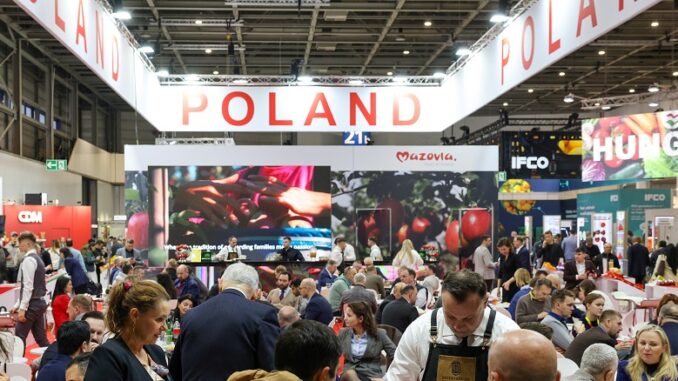
Despite severe winter disruption in Germany, FRUIT LOGISTICA 2026 closed with strong business outcomes, high satisfaction levels among exhibitors and visitors, and clear signals about where the global fresh produce sector is heading.
Around 90,000 participants gathered in Berlin from February 4 to 6, underlining the event’s role as a central commercial and strategic meeting point for the industry even under challenging conditions.
Germany experienced its coldest winter in 15 years during the show, with snow and flight disruptions affecting departures. Yet attendance remained robust, with four out of five visitors travelling from outside Germany.
According to Messe Berlin, the atmosphere on the show floor remained focused and productive throughout. David Ruetz, Senior Vice President of Messe Berlin, said: “We were so impressed with the way our trade visitors and exhibitors rose to last week’s challenges, as fresh produce people so often do. This is a resilient industry, one that knows how to handle challenging conditions and logistical hurdles.”
Strong Commercial Outcomes
Initial results from exhibitor and visitor surveys point to a highly successful edition in commercial terms. Around nine out of ten exhibitors reported satisfaction with their business results, while a similar proportion confirmed plans to return in 2027. Company presentation, new customer acquisition and existing customer engagement were all cited as goals achieved to a high degree.
Trade visitors echoed this sentiment. Well over 90% reported a positive overall impression of FRUIT LOGISTICA 2026 and said they would recommend the event to colleagues or business partners. More than 95% confirmed satisfaction with the commercial success of their visit, while nine out of ten praised both the breadth of products and services on offer and the quality of new contacts made.
Exhibitor feedback reinforced the survey data. Participants from across Europe, Africa, Asia and the Americas described full meeting schedules, strong lead generation and the value of face-to-face discussions in a complex trading environment. Several exhibitors highlighted FRUIT LOGISTICA’s role as a global meeting place where producers, technology suppliers, traders and institutions converge in one location.
Innovation Takes Centre Stage
Innovation remained a core pillar of the event, spanning fresh produce, technology, logistics and sustainability. This was underlined by the presentation of the FRUIT LOGISTICA Innovation Award (FLIA), now in its 20th year.
In the Fresh Produce category, the award went to POMPUR, an apple brand developed by the Niederelbe breeding initiative. POMPUR is certified by the European Centre for Allergy Research Foundation (ECARF) and positioned for consumers with apple allergies. ZIN Managing Director Maik Stölken said: “We have created a product that gives many people access to apples that they previously couldn’t enjoy. In Germany alone, there are between 3.5 and 4 million people with this allergy. Our apple hasn’t come this far just because it’s allergen-free. It also simply tastes good. Today, we are celebrating the result of 20 years of development work.”
The Technology category award went to the L50 Drone from ABZ Innovation, a lidar-based agricultural spraying drone designed for large-scale operations. Gyula Törok, Chief Commercial Officer of ABZ Innovation, said: “This award is a great recognition of our work and means a lot to us. We are the first drone manufacturer in Europe to develop this type of drone. Winning the FRUIT LOGISTICA Innovation Award shows us that we are on the right track.”
Clear Signals For The Future
Beyond awards, FRUIT LOGISTICA 2026 offered a dense programme of discussions and showcases pointing to the industry’s priorities. Across the three days, recurring themes included sustainability trade-offs, supply chain security, data-driven agriculture and the growing role of automation and artificial intelligence.
Debates addressed tensions between environmental goals and economic realities, including questions around long-distance transport of fresh produce and the livelihoods linked to global supply chains. Technology-focused sessions highlighted AI-driven weed control using laser systems, non-destructive quality monitoring through near-infrared and hyperspectral imaging, and the use of sensor data combined with plant models to optimise irrigation.
Sustainability featured prominently, not only in environmental terms but also in social and economic dimensions. Sessions explored biodiversity beyond pollinators, gender equity in leadership, circular approaches to CO₂ use in greenhouses, and secure, drug-free logistics corridors between producing and consuming regions.
Market-oriented discussions examined developments in the global reefer sector, water-efficient production systems, certification complexity, gene editing for future crops, and shifting dynamics in categories such as avocados. Together, these topics reflected an industry navigating climate pressure, regulatory complexity and volatile trade conditions while continuing to invest in innovation and efficiency.
A Resilient Industry Checkpoint
FRUIT LOGISTICA 2026 ultimately served as an early-year checkpoint for a global industry facing uncertainty but still willing to invest, meet and close deals. Despite extreme weather, the show delivered high engagement, measurable business success and a concentrated view of the technological and strategic directions shaping fresh produce markets.
As exhibitors and visitors already look ahead to the 2027 edition, the message from Berlin was consistent: resilience, innovation and collaboration remain central to the fresh produce trade’s ability to adapt and grow.
Find out more at: https://www.potatobusiness.com/